Supporting the Arts in Western Massachusetts and Beyond

August 5, 2013

Music & More at Mahaiwe


Mahaiwe, Great Barrington, MA
by Shera Cohen

Adding to the recent concert reviews at Mahaiwe – in which both The Fab Faux and Mary Chapin Carpenter were highly praised – is Manhattan Transfer.

The four-part harmony of this group, with a resume boasting awards over four decades, brought in a full house of avid fans. Sometimes a capella and sometimes with piano accompaniment, the quartet echoed smooth and often jazzy sounds in a relaxed and intimate concert. Highlights included a tribute to Ella Fitzgerald, several of their own compositions, and audience favorites “I Love Coffee” and “Route 66.”

More than a review, however, In the Spotlight gives kudos to Mahaiwe on its programming, not just in the summer. This, indeed, is a 12-month venue. Art and entertainment genres include music (of course), theatre, dance, lectures, comedy, film, and family shows.

Running from October through May is the Met Opera Live in HD – live Saturday afternoon operas broadcast simultaneously at Mahaiwe. Important to note is that only a few sites in the Berkshires offer this unique series. Coupling the visual elegance of the Metropolitan Opera House in New York City with the grand picturesque Mahaiwe in Great Barrington makes for double the pleasure in seeing the finest opera in this country.

Other series on the stage have been (and will continue to be) the Berkshire International Film Festival, the Berkshire Playwrights Lab, and London’s National Theatre in HD plays. Mahaiwe is also the lovely home of the Close Encounter with Music orchestra and singers.

Music tends to be folksy, 50’s, and New World with lots more packed in. For instance, on any given month there can be 10 performances of numerous arts. Examples of the array of upcoming programs include: Bela Fleck NY Banjo Summit, Pilobolus Dance Company, Bill Cosby, Chef Francine Segan’s Shakespeare’s Kitchen, and (Springfield’s own) Taj Mahal.

For those interested in the theatre’s name, the Mahican Indians’ translation was "the place downstream." I never excelled at geography, so I can’t say if Great Barrington is or isn’t downstream on any lake or other waterway in Massachusetts. I do know, however, that Mahaiwe should be a destination point for some of the best in the arts.

Theatre by the Numbers & in Alphabetical Order


Shakespeare & Company, Lenox, MA
season through September 1, 2013
by Shera Cohen

Let’s look at some numbers at Shakespeare & Company. This venue is abuzz all year, with the bulk of their work produced in the summer months.
  • 4 theatres
  • 10 plays - 3 by Shakespeare and 7 by others (Moliere, Brecht, McNally, Stoppard, McDonagh)
  • 4 lecture/program series (tallies to 28)
  • 7 special performances/events
  • Countless free outdoor shows by Riotous Youth
In six days, I had the opportunity to see five plays, two talks, one rehearsal, and one outdoor mini-play. These are in addition to the one play which I’d already seen (“Richard II,” see review) and the two which I will attend in a few weeks. Apparently, I can’t get enough of Shakespeare & Company.

Now, let’s take a look, in alphabetical order, of the plays on my most recent theatre menu.

Heroes (through 9/1)
The play examines the lives of three WWI French veterans, now living in the same
retirement home. So, it’s another senior citizen piece with interchangeable people and either a warm ending or someone dies. Wrong. Director Kevin Coleman and his cast of superior Shakes & Co. “regulars” proves each man a hero in his own way.

Les Faux Pas (through 8/24)
Photo by Enrico Spada
Costumes reflecting a palette of primary colors make each member of this young cast literally shine. Picture love triangles, really bad sword fighting, cheesy props, slamming doors, shouting and crying, original music with ridiculous lyrics, and lots of laughs. Feature actress Jennie Jadow (the troupe’s funniest leading lady) and here’s a family-friendly play.

Love’s Labour’s Lost (through 9/1)
The king, along with three lords, pledge celibacy and ban women from the castle. Why? It’s a comedy; no one knows or cares. Arriving on the scene is the French queen and three ladies. The guys swoon, are rejected, all does not run smoothly in lust and love. The gals have the upper hand. I’m not sure if the Bard would have enjoyed the 1940’s setting though.

Master Class (through 8/18)
Annette Miller usually stars in a one-man (or essentially one-woman) play annually. In the past, she has shined at Golda Meir and Margaret Mitchell. Miller outdoes herself as Maria Callas in what is a study of and passion for art (specifically classical music) experienced by a renowned operatic soprano in an unkind world.

Photo by Kevin Sprauge
Mother Courage and Her Children (through 8/25)
Olympia Dukakis, at age 82, is a marvel. During a Preview performance, Dukakis – the star of the play and on stage for every scene but two – is a powerhouse actress who takes no prisoners. She commands the stage without scene stealing in this drama (albeit with lots of humor) about war, family, money, and survival.

From Rehearsal to the Real Thing


Tanglewood, Lenox, MA
season through September 1, 2013
by Shera Cohen

What is common between Saturday mornings (10:30am to be exact) in the Berkshires and Sunday afternoons (2:30pm)?

Surely, you could visit many museums; i.e. Berkshire Museum, Chesterwood, Norman Rockwell. You might also explore any of the quaint towns; Lee, Lenox, Stockbrige. And, don’t forget the Lee Outlets; i.e. Vitamin World, Chico’s, and Harry & David (the latter being my eclectic favorites).

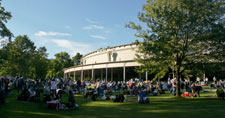
A more a propos, and the correct answer to my question is – Tanglewood. Except for a few changes in schedule (see Tanglewood’s website), Saturday mornings are rehearsal times for the next day’s afternoon concert. Often throughout the summer season, I take in one or the other – rehearsal or concert. On July 27 & 28, however, I enjoyed both “versions” of Dvorak’s Symphony No. 9, dubbed “New World Symphony.” Other pieces in the program included another Dvorak’s piece, “Carnival Overture,” and Prokofiev’s Piano Concerto No. 3.

Why attend a rehearsal? Lots of reasons: listen to the director’s pre-show lecture, attend when the day and time is convenient for you (Saturday vs. Sunday), pay less for a ticket, enjoy a little more relaxed atmosphere, eat a post-concert picnic lunch, appreciate the easier parking. Most important to me, however, and I imagine to others, is a new and different experience of hearing classical music. For example, a conductor often talks to the musicians, giving them suggestions for improvement. Sometimes, entire sections of the music are repeated to “get it” perfect. Not that my untrained ears know the difference, it is obvious that the musicians and the conductor do. Oftentimes, however, an entire piece will run straight through, with some corrections made at its completion. For the audience, the rehearsal’s emphasis is on education.

Why attend the concert instead of the rehearsal? Again, lots of reasons: hear the finished product straight through, mingle with and experience the camaraderie of concert aficionados, spend a little more money (but isn’t it wonderful to support the arts?), lunch at a lovely Berkshires’ restaurant or BYO lunch and eat on the lawn, finish your Saturday grocery shopping and other errands and set Sunday as a day to relax while listening to the BSO (Boston Symphony Orchestra).

As the BSO and Dvorak’s “New World Symphony” – both were exquisite. I had heard bits and pieces of this long piece, but never in its totality under July 28th. Whether listened to as a rehearsal with some starts and stops and director comments or “the real thing” or both, Tanglewood is the epitome of the Berkshires beauty and arts in one location.

Same Time, Next Year


Berkshire Theatre Group, Stockbridge, MA
through August 10, 2013
by Shera Cohen

George and Doris might be the couple who live next door, each in their 30’s, handsome, living their mundane lives. Except, George is married and Doris is married, but not to each other. They begin their one-night stand innocently and soon each character and the audience sees love blossom.

“Same Time, Next Year” is not a new play, and many may have seen the movie version. The eras are the 50’s through the 70’s. In spite of the piece being dated, it is still delightful to glimpse back at the mores, language, and dress of three decades that many of us recall. Yet the retrospective is not a textbook lesson for the audience, but a seemingly true story of growing affection into love of two people.

Corinna May and David Adkins (Doris and George) are evenly matched as they give truth to their characters and situation. Each is a skilled actor, frequent players at Berkshire Theatre, and knows how to connect with their audiences. Through them, Doris and George stretch their outlook and response to the changing world, sometimes in completely different directions. Like an old married couple, they bicker and then make up. Their annual tryst – both funny and poignant – of nearly 25 years will continue beyond the play’s ending. Yet, surprisingly, each has his/her own happy marriage.

Director Kyle Fabel moves the actors in logical ways in and out and around a large rustic hotel room. It must be located in a ritzy section because a piano fills a good part of the upper stage level. Randall Parsons’ set is exquisite, although one might expect a picture or piece of furniture to have been replaced or moved out of place in a quarter-century. While the play is a duet, a crew of four young actors makes the most of their frequent short bits on stage as they change set pieces (primarily making and remaking the bed). With background music from the 50’s to 70’s (Harry Connick?) the team, dressed at maids, is a comic hoot.

“Same Time, Next Year” poses questions about honesty and truth, guilt and even religion. This is a play to think about, but not too deeply.

Vivaldi and Britten


Berkshire Choral Festival, Sheffield MA
July 27, 2013
by Barbara Stroup

The unlikely pairing of works by Vivaldi and Britten provided excellent large-scale choral music for a perfect mid-summer evening in the Berkshires. Conductor Nicholas Cleobury, from the United Kingdom, led over 100 choristers plus orchestra and soloists in Antonio Vivaldi’s Gloria and in Benjamin Britten’s Spring Symphony.

The chorus seemed most comfortable with the familiar Gloria. Orchestra and chorus were well balanced, and the strings kept vibrato to a minimum. In the cavernous Jackman Center, the organ continuo enhanced the orchestra sound (but the player, unfortunately, went unnamed in the program). There were several lush and expressive passages of cello and organ. Under Cleobury’s direction, both orchestra and chorus produced an admirably wide range of dynamics.

Less familiar to all, Spring Symphony of Benjamin Britten was a treat of 20th century sound and revealed the composer’s reverence for text as a source of theme and meaning. Britten used poetry -- medieval to modern -- to write interweaving lines for soloists, chorus, and orchestra sections. His chosen texts conjured a palpable longing for spring to emerge. Put together with a complex texture of sound, the work reminded the listener of that late winter impatience for the sun and flowers to appear.

Spring Symphony required an array of ‘extras’ -- a cowbell, a children’s chorus, and several measures of bird sounds from the soloist, all of which brought smiles. The stark reminder of nearby war was contrasted with the relative calm of England’s hills in “Out on the Lawn I Lie in Bed” which featured mezzo soprano, Ann McMahon Quintero. There was nothing ‘middling’ about her voice; the dark richness was enthralling.

This work, although operatic in its reliance on the solo work of three singers, kept the chorus busy and interwove all. The brass were especially authoritarian and solid. Complex to say the least, kudos to the choristers for learning the piece so well in one week's time, and to the Berkshire Choral Festival for presenting it.

August 2, 2013

Body Awareness


Chester Theatre Company, Chester, MA
through August 11, 2013
by Walt Haggerty

With the aid of a quartet of exceptionally gifted actors, Amherst author Annie Baker, has created an amusing and touching comedy that provides a most enjoyable evening of theatre. “Body Awareness” takes the audience behind the scenes of a more than slightly unconventional modern American nuclear family. 

Phyllis is a college professor responsible for a five-day “Body Awareness” campus event. She and her partner, Joyce, are hosting Frank, a photographer whose photos of female nudes are being exhibited on campus as part of the program. Jared, Joyce’s 21-year old son, who may or may not be suffering with Asperger’s Syndrome, completes the quartet.

Through the astute direction of Knud Adams, the idiosyncrasies’ of each of the characters are unveiled, mostly with kindness and understanding, and always with humor. The tension between judgment and empathy is played out in different ways, with empathy the clear winner.

Caitlin McDonough-Thayer as Phyllis is a not quite secure, controlling partner to Jennifer Rohn’s Joyce, who thinks she has the courage to pose nude. Bruce McKenzie, as Frank, presents the strong, stalwart male image, with two failed marriages in his wake, dispensing fatherly advice to Jared. David Rosenblatt, as Jared, delivers an outstanding performance – immature, confused, and exceptionally bright. Jared is, in many ways, the most interesting character in the group.

Put them together and the result is an amusing, perceptive observation of life in today’s world, expertly presented with warmth and affection.

Annie Baker’s talent has drawn high praise from New York critics following several Off Broadway productions of her work. She is the recipient of an OBIE Award for Best New American Play, as well as nominations for a New York Drama Critics Circle Award, and an Outer Critics Circle Award. Ms. Baker’s plays have been performed in more than 100 theatres throughout the U.S.A., Europe, and South America.

Mark Morris Dance Group

Tanglewood, Lenox, MA
July 31-August 1, 2013
by Michael J. Moran

Choreographer Mark Morris took his annual Tanglewood engagement to a new level this year by directing an innovative double bill of two one-act operas by English masters: Britten’s “Curlew River” (part of Tanglewood’s observance of that composer’s centennial) and Purcell’s “Dido and Aeneas.” Morris’s production of Dido was introduced in 1989, but the Britten was a world premiere.

Mark Morris
The first of three “parables for church performance” that Britten composed in the 1960s, the hour-long “Curlew River” is based on the medieval Japanese No play “Sumidagawa.” The moving story of a mother searching for her lost son is told by a group of monks, several of whom play solo roles in the drama. The thirteen singer/actors and seven instrumentalists were all Tanglewood Music Center fellows who intermingled on the stage of Ozawa Hall, set only with benches draped in white cloth, matching the performers’ simple costumes.

Everyone brilliantly captured the exotic, otherworldly quality of the austere music, and while all the featured soloists were compelling, the overwhelming emotional force of tenor Isaiah Bell’s performance as the “Madwoman” (the mother) deserves special praise. 

Stefan Asbury conducted the Purcell piece, which featured dancers on stage, while twelve chorus members, three vocal soloists, and thirteen instrumentalists, performed on the balcony above. Each character was thus portrayed simultaneously on two levels by a singer and a dancer.

Morris’s choreography expressed the varying moods of the drama in apt and imaginative ways. The chorus’s hearty cackles in Scene 2 were amplified by the dancers’ reckless abandon in the dance of the furies. Their individual slow-motion exits in Dido’s concluding death scene were deeply moving. The entire ensemble was again impressive, but Laurel Lynch (Dido) and Spencer Ramirez (Aeneas) danced most outstandingly. Soprano Marie Marquis (a perky Belinda), mezzo-soprano Samantha Malk (a lush Dido), and baritone Steven Eddy (a commanding Aeneas) sang most eloquently.