Supporting the Arts in Western Massachusetts and Beyond

Showing posts with label Close Encounters with Music. Show all posts

May 23, 2023

REVIEW: Close Encounters with Music, "Escher String Quartet"

Mahaiwe, Great Barrington, MA 
May 21, 2023 
by Michael J. Moran 

The Escher String Quartet
Introducing this concert of three diverse pieces with his trademark humor and erudition, CEWM Artistic Director Yehuda Hanani noted the common links of the composers to the "folklore of their native lands" and their shared "interest in music for children."   

The Escher String Quartet (violinists Adam Barnett-Hart and Brendan Speltz; violist Pierre LaPointe; cellist Brook Speltz), founded in 2005 and based in New York, played the first two works on the program. It opened with a sumptuous account of Maurice Ravel's 1903 Quartet, whose forward-looking harmonies drew mixed reactions from his French contemporaries: alarm (Gabriel Faure) and enthusiasm (Claude Debussy). The Eschers delivered a lush "Allegro moderato - tres doux," a brisk "Assez vif - tres rhythme," a pensive "Tres lent," and a rousing "Vif et agite."
 
In sharp contrast, Ruth Crawford Seeger's "1931 Quartet" offered clashing dissonance in four short, densely concentrated movements. But Hanani also urged the audience to listen for the “childlike wonder and adventure” in the music.  The poignant "Andante" became so popular that Seeger (a prominent scholar of American folk music and stepmother of folksinger Pete Seeger) later arranged it for string orchestra. The Eschers' powerful reading of this groundbreaking modernist work was virtuosic and intensely focused. 

For Pyotr Ilyich Tchaikovsky's 1890 string sextet, "Souvenir of Florence," they were joined by cellist Hanani and nationally acclaimed violist Daniel Panner in a vibrant performance. While reflecting the composer's fond memories of visiting that city in Italy, the last two movements are nevertheless distinctively Russian in flavor. The group fashioned a brilliant "Allegro con spirito," a flowing "Adagio cantabile e con moto" (which sounded, in Hanani's words, almost "like an Italian opera aria"), a vigorous "Allegretto moderato," and a headlong "Allegro con brio e vivace." 

Named after the Dutch graphic artist M. C. Escher, the quartet members not only demonstrated his "method of interplay between individual components working together to form a whole" blended sound, but they vividly showcased a vast range of string ensemble writing over a forty-year period in their imaginative program. 
 
The CEWM season will conclude at Mahaiwe on Sunday, June 11, 2023 at 4:00 pm.

May 31, 2022

REVIEW: “Reeds and Strings,” Close Encounters with Music

Mahaiwe Performing Arts Center, Great Barrington, MA 
May 29, 2022 
by Michael J. Moran 

Introducing this concert with his usual mix of erudition and wit, CEWM Artistic Director Yehuda Hanani identified music for reed instruments with Dionysus, god of fertility (“the music of heavy breathing”), and music for strings with Apollo, god of beauty and patron of the arts. Thus, the solo oboe piece by Britten would sound quite different from the Beethoven string trio, while the Mozart and Cimarosa works for reeds and strings would achieve “a happy balance” of earthly and celestial delights. 

Liang Wang
The opening performance by oboist Liang Wang, violinist Itamar Zorman, violist Michael Strauss, and cellist Hanani of Mozart’s 1781 oboe quartet accordingly exuded classical poise and elegance, from a lively “Allegro” through a tender “Adagio” and a graceful closing “Rondeau: Allegro.”   
  
Wang next took the spotlight for a literally breathtaking account of Benjamin Britten’s 1951 “Six Metamorphoses after Ovid” for solo oboe. Each section depicts a character in Roman mythology, and Wang, principal oboe of the New York Philharmonic, met the piece’s daunting technical challenges with virtuosic flair. Highlights included: the sensuous rhythmic complexity of the flutist Pan; the relentless speed of charioteer Phaeton; and the quiet poignancy of bereaved mother Niobe.
  
Zorman, Strauss, and Hanani then returned with an incandescent rendition of Beethoven’s inventive third string trio, Op. 9. A stormy opening C minor “Allegro con spirito,” a passionate “Adagio con espressione,” an energetic “Scherzo – Allegro molto e vivace,” with a gentle trio interlude, and a powerful “Presto” finale foreshadowed the pathbreaking mature composer who emerged shortly after this early (1799) masterpiece. 

Violinist Susan Heerema joined Wang and the string trio to close the program with Domenico Cimarosa’s 1790s oboe concerto. As Hanani promised, the Apollonian grace of the solemn “Introduzione” and the flowing “Siciliana” perfectly complemented the Dionysian exuberance of the alternating “Allegro” and “Allegro giusto” movements.   

The CEWM season will conclude on June 12, 2022 with “Musica Latina,” featuring Flamenco dancer Irene Rodriguez and a selection of Spanish music.

All Mahaiwe events, including CEWM concerts, require proof of vaccination and a photo ID for entry and masking inside the theater.

Editor's note: Mr. Moran's final paragraph, like reviews by myself and our writers, has become rote. By now, even though Covid is still very much with us, I usually gloss over this language. However, I have learned that I must heed these warnings. Unfortunately, I was unable to attend this concert because, while I did wear my mask (I even had an extra) and my ID, it didn't occur to me to bring my vaccination card. I had changed purses prior to the hour and a half drive to Great Barrington, and forgot to transfer the ID. Whether the ID is a Mahaiwe rule or that of Close Encounters, I don't know. Having been to at least a dozen arts events since Covid subsided a bit, I have yet to be asked to see my vaccination ID. My advice in the case of Close Encounters, and any venue, is to read the fine print.

May 9, 2022

Preview: Close Encounters with Music, "Reeds and Strings"

Mahaiwe, Great Barrington, MA
May 29, 2022

The organic voice of the oboe, a member of the woodwind family, meets kindred wood string instruments at the May 29 Close Encounters with Music performance on May 29 at 4pm. First oboist of the New York Philharmonic leads the way from Mozart’s Oboe Quartet to Cimarosa’s Oboe Concerto and Benjamin Britten’s Six Metamorphoses after Ovid, a musical masterpiece that will be accompanied by images of historic paintings of the mythological tales.   

Liang Wang
The Metamorphoses is Ovid's longest extant work, a continuous epic poem in 15 books. Based on the poetry of Hesiod and Callimachus, it features a collection of separate stories linked by the common theme of transformation. A tour de force for oboe players, the programmatic work is a refresher course in Roman mythology and a rare experience for listeners to enjoy the full range of the oboe—from seductive to weeping to simulating flying chariots and thunderbolts, fountains and drunken feasts. 

Oboist Liang Wang is joined by violinists Itamar Zorman and Susan Heerema, violist Michael Strauss, and Close Encounters artistic director and cellist Yehuda Hanani. Zorman, Strauss and Hanani also perform the Beethoven String Trio in C minor, written in his dramatic, misterioso key, with constant dialogue between minor and major, darkness and light.s also an active arranger and editor of scores, as he rarely finds p

December 13, 2021

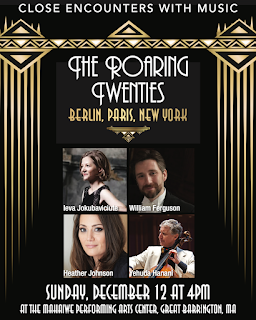
REVIEW: Close Encounters with Music , “The Roaring Twenties”

Close Encounters with Music, Great Barrington, MA 
December 12, 2021 
by Michael J. Moran 

Since the second live concert by Close Encounters with Music at the Mahaiwe was subtitled “Berlin, Paris, New York,” an ingratiating account of the 1924 Gershwin classic “Fascinating Rhythm” by tenor William Ferguson and pianist Ieva Jokubaviciute was an apt and delightful opener. CEWM Artistic Director and cellist Yehuda Hanani then introduced the program with his trademark humor and erudition, gleefully quoting Cole Porter’s “Anything Goes” to characterize the vocal and instrumental music of the 1920's.

Pianist Renana Gutman next brought dazzling dexterity to the almost shockingly modern-sounding 1927 “Five Jazz Etudes” by Czech composer Erwin Schulhoff, who perished in a Nazi prison camp in 1942. American Samuel Barber’s 1927 cello sonata followed, a “sunny piece,” in Hanani’s words, “without an ounce of cynicism,” written when the composer was just seventeen. Hanani and Jokubaviciute were expressive in the opening “Allegro ma non troppo,” tender and mercurial in the central “Adagio,” and visceral in the “Allegro appassionato” finale.

For the second half of the concert, Ferguson and Jokubaviciute were joined by mezzo-soprano Heather Johnson in a wide-ranging selection of more and less familiar songs by composers active in all three cities during the 1920s. While projected translations of the French and German lyrics would have been helpful, both singers enunciated their texts so clearly and acted them so skillfully that their meaning always came through in the Mahaiwe’s plush acoustic.

Highlights included: Johnson’s incisive “Supply and Demand” by Hanns Eisler and Bertolt Brecht, her sensuous “Speak Low” by Kurt Weill and Ogden Nash, and her dramatic “La Vie en Rose” by Marguerite Monnot and Edith Piaf. Ferguson’s varied trio of chansons by Francis Poulenc, his powerful “Bilbao” by Weill and Brecht, and his lively rendering of Dave Frishberg’s hilarious “Another Song about Paris” were a fitting tribute to the recently deceased jazz master; and Jokubaviciute’s exquisitely sensitive and versatile pianism throughout the program.

Next up for CEWM is a “Folk and Baroque” program, featuring guitarist Eliot Fisk, contralto Emily Marvosh, and Hanani, at St. James Place in Great Barrington on February 26, 2022.

All Mahaiwe events require proof of vaccination and a photo ID for entrance and masking inside the theater. 

April 30, 2021

REVIEW: Felix, Fanny, and Frederic, Close Encounters With Music

Close Encounters With Music, Great Barrington, MA
www.cewm.org
April 25, 2021
by Michael J. Moran

Yehuda Hanani
Close Encounters With Music continues to present virtual chamber music concerts from the Mahaiwe Performing Arts Center in Great Barrington during the Covid pandemic. Their latest program, recorded on the Mahaiwe stage before a small live audience, featured Romanian-born violinist Irina Muresanu, Boston-based pianist Max Levinson, and CEWM Artistic Director and cellist Yehuda Hanani. It is available on the CEWM web site.

The concert’s full title was “Felix, Fanny, and Frederic: Chopin and the Mendelssohns.” In his typically witty and cogent introductory remarks, Hanani made clear that while Felix and Frederic knew and respected each other professionally, their musical and personal temperaments were worlds apart: Felix Mendelssohn was gregarious and comfortable in a wide range of public roles, while the crowd-averse Frederic Chopin channeled all his passion into his music. 

No better illustration of this point could be offered than the fiery performance by Levinson of Chopin’s 1840 second piano sonata that opened the program. The “Grave – Doppio movimento” first movement was alternately warm and turbulent, while the following “Scherzo” offset a tempestuous main theme with a sensuous trio interlude. The famous “Funeral March” was somber and stark, after which the astonishing minute-long “Presto” finale flashed by in a chromatic blur. Hanani then joined Levinson in a charming account of the tender “Largo” movement from Chopin’s sonata for cello and piano.  

Fanny Mendelssohn received “the same musical education and gifts” as her four-years-younger brother, Hanani noted, but “proper roles” for women of her time and class limited her potential as a composer and performer to a small circle of family and friends.  Based on the lovely “Adagio” for violin and piano which Muresanu played with silken tone and Levinson with delicate finesse, Hanani might consider exploring more of the 450 pieces which Fanny wrote.

The full trio closed the program with a powerfully dramatic rendition of Felix’s first piano trio. The opening “Molto allegro ed agitato” was commanding, followed by a ravishing “Andante con moto tranquillo,” a light-as-a-feather “Scherzo,” and a muscular, passionate “Finale,” overflowing with what Hanani called Mendelssohn’s “uplifting optimism and unwavering hope.” Sound and video quality were straightforward, conveying a good sense of the hall.


April 6, 2021

REVIEW: Close Encounters with Music, Sebastians Baroque Ensemble

Close Encounters with Music, Great Barrington, MA
www.cewm.org
April 3, 2021
by Michael J. Moran

Like many other musical organizations, Close Encounters with Music has pivoted from live chamber music concerts at the Mahaiwe Performing Arts Center in Great Barrington to virtual presentations during the Covid pandemic. Their latest program, recorded without an audience on the Mahaiwe stage, featured the New York-based Sebastians Baroque Ensemble and is available on the CEWM web site.

Introductory remarks by CEWM Artistic Director and cellist Yehuda Hanani contrasted the Baroque era’s “serene certitude of an orderly cosmos” with the past year, when we’ve become “unmoored by the pandemic.” Sebastians violinists Daniel Lee and Nicholas DiEugenio, cellist Ezra Seltzer, contrabassist Nathaniel Chase, traverso flutist David Ross, and harpsichordist Jeffrey Grossman opened the concert with Johann Sebastian Bach’s fifth Brandenburg Concerto. A lively opening “Allegro,” highlighted by Grossman’s “Dionysian, orgiastic” solo (in Hanani’s words), was followed by an intimate “Affettuoso” and a romping “Allegro” finale.

Hanani then joined Grossman in an alternately soulful (in the two Largos) and stirring (in the two Allegros) account of Antonio Vivaldi’s fifth sonata for cello and harpsichord. Lee, DiEugenio, Seltzer, and Grossman were stately or spirited in the four short movements of Nicola Porpora’s sixth “Sinfonia Da Camera.” Ross was a buoyant soloist, with sprightly support from Lee, Seltzer, and Grossman, in a flute quartet by Bach’s son, Carl Philipp Emanuel.

A brief overture by Vivaldi, with three one-minute movements, whirled past in an urgent rendition by the four string players and Grossman. The concert closed with an elegant interpretation of George Frederick Handel’s “Trio Sonata in G Minor” by Seltzer, Lee, DiEugenio, and Grossman. In a post-concert conversation with Hanani, the latter three musicians were hopeful that music-making will bring “something better” after the pandemic, including “more options” for live and virtual performances.  

While Brandenburg Five might have been more effective dramatically as a concert closer than as an opener, the program was an enlightening overview of Baroque music, combining more and less familiar pieces. The last CEWM virtual concert of the current season, “Felix, Fanny and Frederic: Chopin and the Mendelssohns,” will stream live on April 25 at 7:30pm.


May 9, 2017

The Los Angeles Guitar Quartet


Close Encounters with Music 
Mahaiwe Arts Center, Great Barrington, MA
May 7, 2017
by Rebecca Phelps

This year Close Encounters With Music celebrates its 25th season presenting creative programming for smaller venues in and around Great Barrington. The Los Angeles Guitar Quartet was their penultimate concert of the 2016-17 season and was a huge hit with the audience.

Beginning with music from the time of Cervantes, arranged and narrated by LAGQ member William Kanengiser, the concert was off to an engaging start. William Kanengiser is not only a talented guitarist and arranger, but indeed a gifted actor, who told the story of Don Quixote and his sidekick Sancho Panza, interspersed with short, delightful Spanish renaissance dances. Kanengiser included castanet, tambourine, and drum-like effects on the guitars.

Bach’s 6th Brandenburg Concerto was arranged for the quartet by their former college professor, James Smith, to whom the LAGQ remains deeply indebted. It was in his studio where they originally met and became an ensemble; three of the four members have remained together for 37 years!

The Three Brazilian Pieces, which came next, represented a small sample of a project the LAGQ undertook in 2007 in which they studied, performed and recorded several Brazilian works. Each piece which they performed represented a different aspect of Brazilian music; the first by contemporary jazz composer Hermeto Pascoal, the second (originally for piano) O Lenda da Caboclo, by Heitor Villa-Lobos, and lastly a traditional samba - Samba Nuovo; highly energized and lots of fun.

La soiree dans Granade from “Estampes” by Claude Debussy was another of James Smith’s arrangements; a perfect choice as the original piece depicts a scene of the Alhambra in Granada and is, in its original form, a piano imitating guitars! Stunningly beautiful in either form.

The final set of was another of William Kanengiser’s arrangements, this time  a suite of movements from Bizet’s famous opera Carmen; another selection featuring guitaristic sounds depicting the much loved dances and melodies made famous by the bewitching Spanish Carmen.

The LAGQ brought the audience to its feet with their creative programming, their virtuosity that never gets in the way of music making, and their obvious enjoyment of performing together. Bravo!

October 24, 2013

Anatomy of a Melody


Close Encounters with Music, Mahaiwe, Great Barrington, MA
October 19, 2013
by Barbara Stroup

Because the concert title seemed to require it, and to bring clarity to the evolution of this world premiere, some background explanation was provided at this Close Encounters' concert. Cellist Yehua Hanani provided cogent details so that the audience would have a more critically tuned ear for the appearances of a singular musical element. Hanani described the source of the melody, the early opera tune “Love the Sailor,” helping listeners to further appreciate the skill composers use as they weave variations over a single theme.
Beethoven, for instance, used it in the 3rd movement of his piano trio Opus #11.

The highlight of the evening was the premiere performance of a commission by composer Paul Schoenfield who titled his use of the theme “Shaatnez for Ady.” Ady was present in the audience and far from alone in appreciating this modern composition. The piece was complex, tuneful, harmonic, bright, and the conclusion brought the audience to its feet. The piece was generously commissioned through the organization itself and if only every local musical group could manage this same generosity, audiences could continue to revel in Schoenfield’s skills.

For the trio and the commissioned piece, Hanani was joined on the stage by Miriam Fried (violin) and Renana Gutman (piano). These musicians exemplified all that is best about chamber music – a sensitivity to each other’s line when required, and a joy at leading when that opportunity was clearly their own. Perfectly balanced as a threesome, the sound periodically blurred during the final piece by Brahms. Perhaps the change from three lines to four was too abrupt for this venue or too sudden for these ears.

The venue itself deserves mention: the Mahaiwe has magic as one approaches the twinkling neon marquee and is drawn into the renovated facility, which shines in its refurbished state and lends itself to happy audiences with good sightlines and fine acoustics. Both this pleasant atmosphere and the early hour of the performance lent a feeling of being in the artists’ living room for an intimate evening of music making

This concert marks the beginning of the “Close Encounters with Music” season, which includes five more concerts between now and June 2014 at various venues in the Great Barrington area.